
There is a pattern in how senior operations leaders think about the visibility problem — one the process intelligence stack answers differently at every layer. It goes something like this:
- Consume all the operational data.
- Cross-reference it across systems.
- Throw an LLM on top so the team can query it in plain language.
- Surface the patterns. Flag the failures.
It is the answer most people land on when they think carefully about the problem for the first time. And it would be genuinely useful.
It also gets you about 60% of the way.
How does process intelligence differ from a data warehouse?
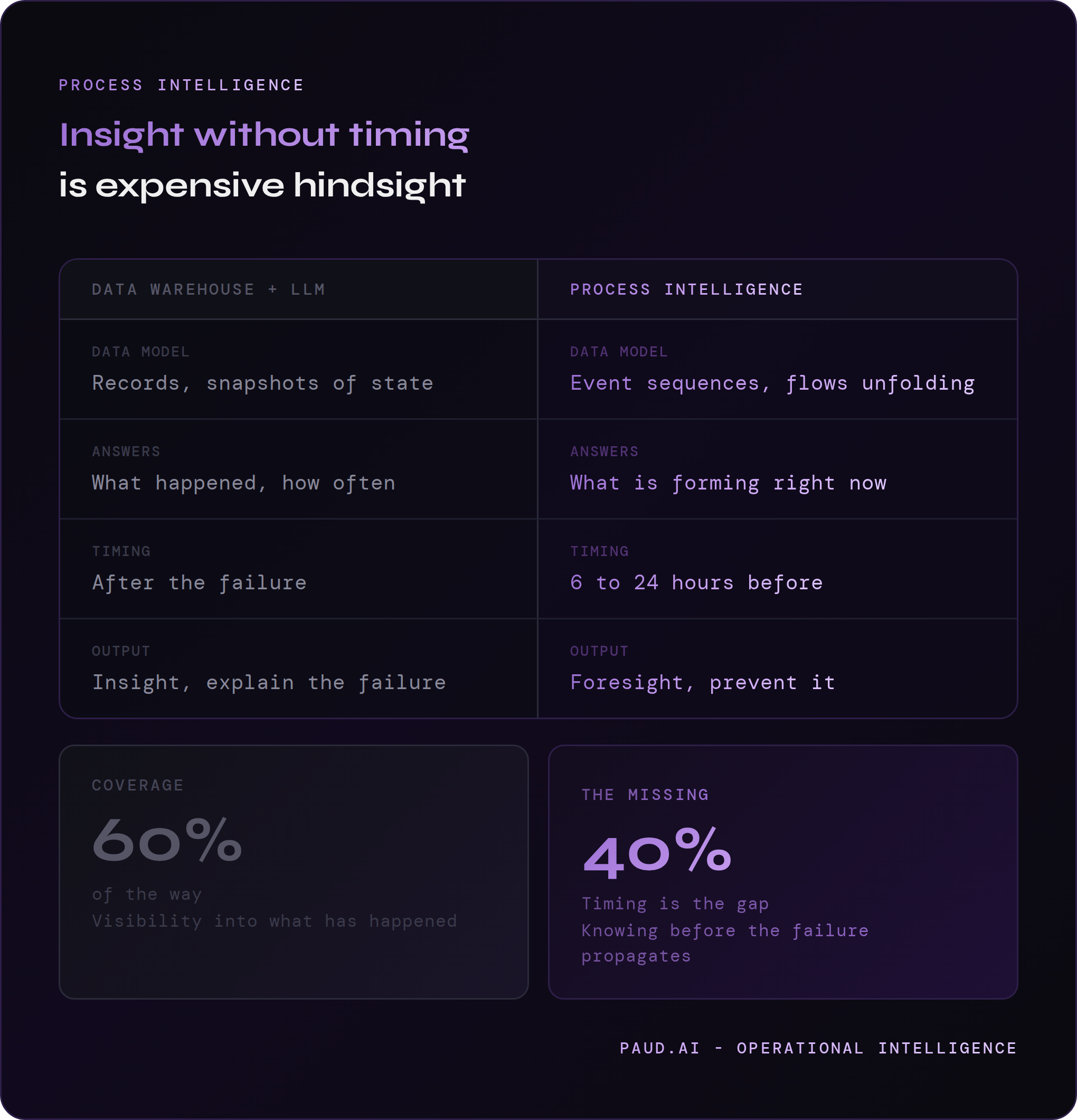
A data warehouse models operations as states. It shows what has happened or what is currently happening across metrics and dashboards. Process intelligence models operations as flows of events: it identifies the sequences that lead to failure and uses them to predict which processes are likely to break before they do.
That is the whole difference, and everything below follows from it. For what process intelligence is in its own right — the seven layers, and where this sits among them — start there.
The operational visibility gap nobody on the floor is talking about
A data warehouse plus an LLM is a very sophisticated version of the same problem it is trying to solve.
It can tell you what failed and how often. It can let you ask "what were the most common failure patterns last month?" in plain English and get a coherent answer. What it cannot tell you is what is about to fail.
The reason is architectural.
A data warehouse treats operational data as records. These are snapshots of state at a point in time. An LLM reasons over those records. Both are looking at what has already been written into the log.
Prediction requires something different. It requires treating the data not as records but as sequences. Ordered events that form a process, where the sequence itself carries information about where the process is heading.
That distinction sounds technical. The practical difference is significant.
Records vs event logs
Take a failed customer order in a retail or B2B SaaS operation.
A data warehouse plus LLM approach will tell you, after the fact, that the order failed. It will let you query the failure pattern. It will help you build a report. If you have enough historical data it will tell you that orders with certain characteristics fail at a higher rate.
A process intelligence approach treats every active order as a sequence of events unfolding in real time.
It knows that this order, right now, has followed steps A, B, and then skipped C before arriving at D.
It knows that in 87% of historical cases where that specific sequence occurred, the order failed within six hours.
The order has not failed yet.
You still have the window to intervene.
Same data. Different lens. Completely different outcome.
Why this matters more as operations scale
The data warehouse plus LLM answer gets more attractive as data volumes grow. More data means better pattern recognition. Better pattern recognition means better reports. Better reports mean your team makes better decisions.
But scale also means the intervention window gets shorter.
In the UK mid-market, B2B SaaS companies between £20M and £60M ARR have already invested in a warehouse and a layer of LLM-powered querying on top. The architecture handles board reporting and self-serve analytics. It does not catch the £180k order that is going to slip out of the quarter because three approval steps take fifteen days each instead of three.
That is a sequence problem, not a record problem.
More orders. More suppliers. More channels. More dependencies.
By the time a failure shows up in a KPI, it has already propagated across multiple downstream processes.
Insight without timing is expensive hindsight. Most teams do not have a data problem. They have a timing problem. The larger the operation, the more you need to know what is forming, not what has formed.
The 60/40: what a data warehouse plus LLM cannot predict
The data warehouse plus LLM gets you roughly 60% of the way to operational visibility.
It answers: what happened, how often, what it looks like, what you can query about it.
The other 40% is where the leverage sits: what is happening right now that is about to become a problem, which processes are about to fail, how much time you have to intervene.
It is not a subtle shift. It is the difference between explaining failures and preventing them.
Most operations teams do not have this yet.
Not because the idea is new. Process mining has existed for decades at enterprise scale. But because the tools that do it have historically required long deployments and significant investment. That is the gap that is closing.
The operations leaders who close it first will have a meaningful advantage over the ones still reading last month's reports.
For a complete breakdown of what process intelligence is and how the stack works from event logs to digital twins, see What Is Process Intelligence?.
For real-world examples of what becomes visible when you shift from sampling to process tracing, see Audit Failures That Process Intelligence Would Have Caught.